

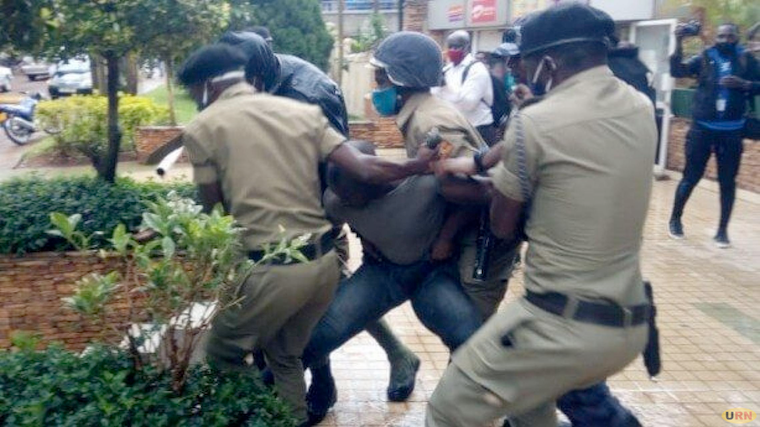
How could we not know, given our tumultuous history, and with the fresh graves born of violence? Who of a working conscience wouldn’t know or hate violence when they watch news of police and army conduct during the ongoing presidential campaigns?
Perhaps the state’s intention is to make us hate violence by ruthlessly exercising and displaying it. As a parent, I always encouraged my little children to follow developments in their country. News at 9pm would often find us waiting together. When I hadn’t been able to watch, they would brief me on what I missed.
Today, I find it very painful to watch news with them, because it is always packed with police and army violence. For these little ones, police and army mean violence. Even when we meet someone in such uniforms on the way, the youngest one hides behind me.
Within intervals of such violence on our screens, someone comes urging citizens to shun protests and violence – to be peaceful. There is clear indication that the senders of the message are worried about something horrible that could happen after the elections.
It is also clear that many are avoiding the potential cause of what they fear to happen. Hence they choose to conveniently speak to consequences. What is likely to cause post-election violence in Uganda? Is it because the public does not know the importance of peace?
As we condemn protests, why are many of the ads silent about their ultimate cause? Why are the senders of the message keener on demobilising angry people than on addressing the causes of their anger (or doing both)? Why are many of them silent about the fact that demonstrating as a constitutional right is practically criminal in Uganda today, and that this pushes people to look for alternative means of expressing dissatisfaction?
When did Uganda last have a demonstration against government (in) action that was okayed by police? Why would the organisations funding these peace messages put most of their focus on calming down the victims than as well calling the oppressors to order? Aren’t their messages both intently and inadvertently serving the oppressor?
After the 2016 elections, we co-authored a journal article with Henni Alava titled ‘Religious (de)politicisation in Uganda’s 2016 elections’ that details how this dynamic played out then.
This time round, the fear seems to be deeper, and the peace calling messages more. In 1977, the legendary reggae artiste Peter Tosh released a song titled Equal Rights where he sings that: ‘Everyone is crying out for peace, yes, none is crying out for justice.
I don’t want no peace, I need equal rights and justice… Everybody is talking about crime, tell me who are the criminals?’ Around the same time, Tosh’s contemporary, Bob Marley, released the song War where he paraphrased Emperor Haile Selassie’s iconic speech at the United Nations General Assembly of 1963.
In the song, Marley counsels that until the philosophy that holds one group superior and another inferior is finally and permanently discredited, there will be war. The dream of lasting peace will remain as a fleeting illusion to be pursued, but never attained.
And until the ignoble and unhappy regimes that hold our brothers [and sisters] in sub-human bondage have been toppled, utterly destroyed, there will be war and rumours of war. These lyrics should speak to our interventions in these uncertain times so that we rise above superficial cries for peace.
In my view, Marley and Tosh’s songs were not, as such, calls to war. Rather, they were meant to sensitise the world to the actual causes of war and instability. They can be summarised thus: if you want peace, work for justice. It is vain and utterly pretentious to call for peace while remaining silent about the injustices that cause instability.
In this electoral season, the real questions behind our fears about the post-election period are: what will happen if the election is rigged (as the signs of bias and impunity are already glaring)? What will the cheated masses do? Aren’t they going to become violent?
Isn’t the state going to kill many people in response and paranoia – as sampled in the recent protests where over 50 were killed in just two days? If these are our fears, as I suspect, why are the messages for peace not as well calling for free and fair elections in order to prevent the consequences of unfair elections?
Why are some of these individuals and institutions silent about the ongoing daily brutality and unfair conduct of state institutions that are spiralling public anxiety and anger? Why aren’t many of them addressing the Electoral Commission that is acting blind to the impunity in the campaigns and already showing sides?
Should we assume that these good peace campaigners are not aware that the conduct of the Electoral Commission is key to determining the post-election situation? Many of these peace crusaders are acting like traditional ssengas (aunties) that counsel women never to fight back their violent husbands.
‘If you want peace in your home, let the man do what he wants. A good wife should never question her husband if that is likely to make him angry and violent. A peaceful wife is one who obeys her husband at all times and finds ways of accommodating his excesses’.
Dear peace trumpeters, if peace and calmness is all you can tell us amidst all that is happening, you are part of the problem.be war and rumours of war. These lyrics should speak to our interventions in these uncertain times so that we rise above superficial cries for peace.
jsssentongo@gmail.com
The author is a teacher of philosophy.